
In Conversation with Francis Pitts, Chair of Design in Mental Health Network – North America
For much of Francis Pitts’ career, the challenge wasn’t convincing himself that the design of mental health environments mattered.
It was finding the other people who believed it mattered too.
“I was looking for kindred spirits,” he says.
It is a phrase that comes up repeatedly when Francis talks about the journey that has led to the creation of Design in Mental Health Network – North America (DiMHN-NA).
That journey stretches back decades, across healthcare systems and professional disciplines, and, quite literally, across the Atlantic.
Now, as DiMHN-NA prepares to formally launch as a new charity in September 2026, Francis believes the opportunity is bigger than creating another professional organization.
It is about creating a community.
One that brings together people with lived experience, clinicians, designers, architects, researchers, health systems, manufacturers, and others who influence the places in which mental health care happens.
And, importantly, one that is prepared to learn from one another.
Because if Francis’s career has taught him anything, it is that none of us has all the answers.
Seeing the Person Before the Role
Some of Francis’s earliest lessons about mental health design came from two projects that, on the surface, had very little in common.
One was a monastery. The other was a center for adolescents experiencing significant emotional difficulties, where Francis had worked as a recreational therapist while putting himself through college.
As an architecture student, he had persuaded his professors to let him work on a monastery project for a small group of monks he knew. After graduation, those same monks asked him to design a small monastery in the Adirondacks.
A year or two later, the architectural practice where Francis was then the junior member of staff was commissioned to work on a forensic mental health hospital.
It was an unusual combination of experiences, but Francis began to see something others perhaps did not.
“The monastery had more to do with a mental health care setting than anyone had ever considered,” he says. “The human issues and the human dynamics of both places were jarringly similar.”
Both needed privacy and community. Places to withdraw and places to connect. Space for the individual and space for collective life.
The difference was how we thought about the people inside them.
“We think about them in their role first and foremost, not in their humanness.”
A person becomes a patient. Another becomes a clinician or caregiver.
And, Francis argues, we can begin designing around what we think those roles require rather than asking a more fundamental question: What does this human being need from this environment?
It is an idea that would shape the rest of his career.
Looking Beyond Safety
By the late 1980s, Francis was actively searching for others interested in the same questions.
He joined the American Institute of Architects’ Academy of Architecture for Health expecting to find them.
Instead, conversations about mental health environments tended to revolve around prescriptive guidelines, regulations, patient safety, supervision, and the dos and don’ts of secure settings.
“It was all command and control stuff, and that’s not where my head was at.”
Francis does not dismiss those considerations.
“That stuff’s important. But it’s only a part of the picture.”
His concern was what happened when safety and risk became the entire picture.
Elsewhere in healthcare, Francis found a different community emerging around therapeutic environments and patient-centered care. He became deeply involved, eventually serving as president of the Academy, and watched those ideas help fundamentally change the modern American general hospital.
Throughout it, the same question stayed with him.
Why shouldn’t we be thinking this way about mental health environments too?
A Month in Europe, a Scale Problem, and a Window
Years later, Francis persuaded his partners at architecture+ to give him a month away from the practice and traveled around Europe visiting mental health facilities and psychiatric units. (“part-sabatical, part busman’s holiday”)
He encountered different care models, different attitudes toward environments, and plenty that he believed North America could learn from.
But he also encountered a barrier to that learning.
His European colleagues would see the enormous scale of the North American projects Francis was describing, and the size of the buildings could overwhelm the conversation.
Francis eventually found an unlikely way of explaining it: Jessica Rabbit.
In Who Framed Roger Rabbit, Jessica famously says, “I’m not bad. I’m just drawn that way.”
North American facilities, Francis argued, were also “drawn that way” by a particular healthcare system, geography, regulatory context, and operational reality.
Get beyond the scale, and there was a much more interesting exchange to be had.
“We could learn from our European colleagues, and they could learn from us.”
Sometimes that learning was philosophical. Sometimes it was a window.
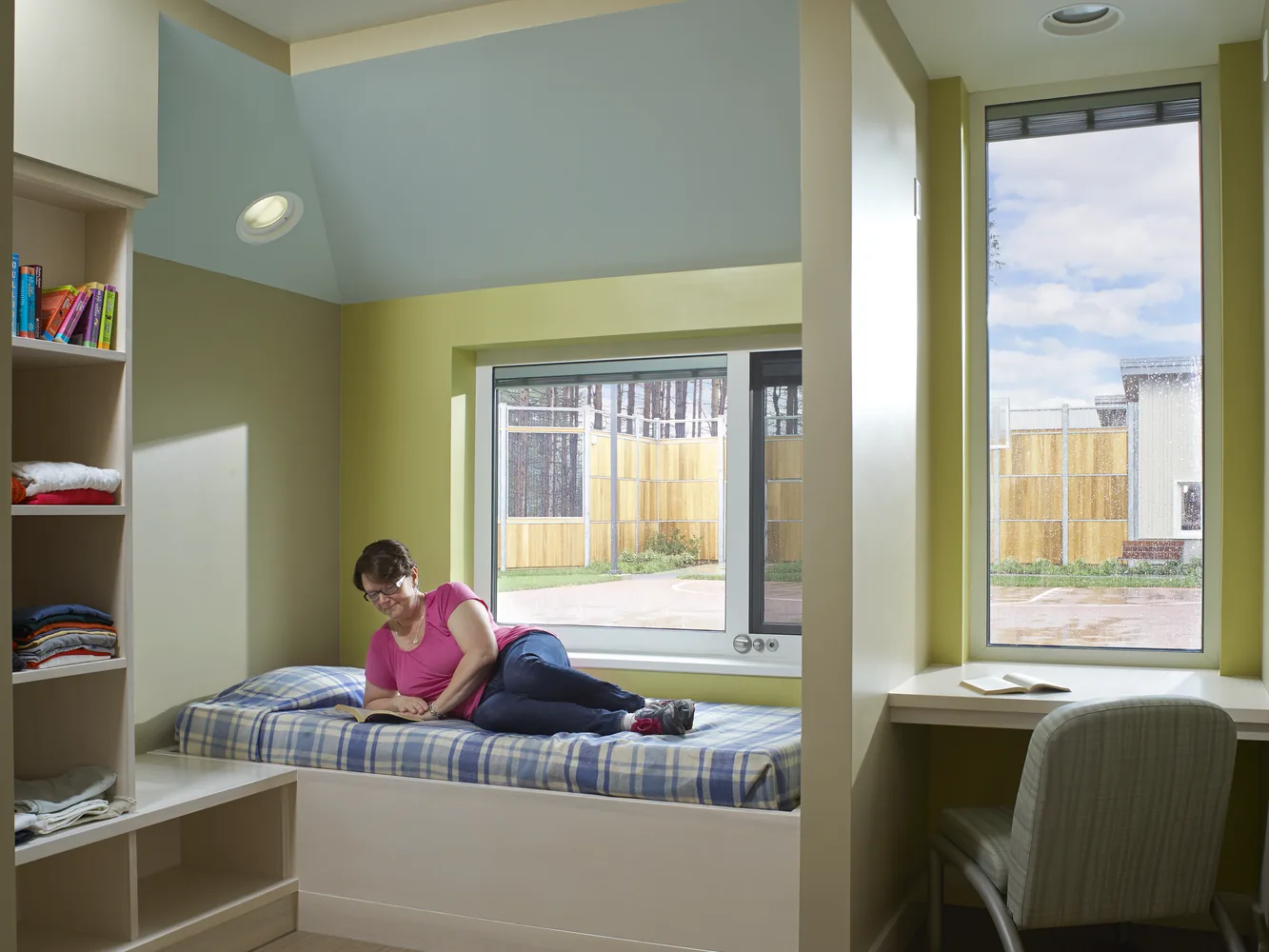
On that trip, Francis encountered a fully ventilating sliding window that resisted impact and addressed ligature concerns. Crucially, it looked like a normal window.
“We set out to find out who made the window.”
The story is small, but it captures something fundamental about Francis’s thinking.
Somebody, somewhere else, had approached a familiar problem differently.
Rather than assuming established practice was the only possible answer, you could look outward, learn, adapt, and ask better questions.
That experience helped deepen Francis’s relationship with the Design in Mental Health Network in the UK, where he found more of those kindred spirits he had been seeking.
From Five People to a Field
Francis has been involved with the UK Network since his first conference appearance in 2012.
The possibility of creating a North American branch was discussed even then, but the timing was not right. The UK Network was still developing, and creating something meaningful across the Atlantic required more than simply adopting a name.
So the idea waited.
At that time, Francis remembers the specialist mental health design community in North America as remarkably small.
He knew a handful of people doing serious work in the field.
“It was a field of five people.”
Today, that picture is almost unrecognizable.
Francis’s own practice has now worked alongside approximately 110 to 120 other architectural firms on mental health projects across the United States and Canada.
“That’s a hell of a lot more people than the five that I originally found.”
Mental health design has become a substantial field. Research has developed. Manufacturers are innovating. Health systems are investing. A new generation of clinicians, designers, researchers, students, and people with lived experience are asking different questions about what these environments can and should do.
For Francis, that changes the opportunity.
It is no longer about finding five people who care.
It is about connecting a community that already exists, and using this network as a breeding ground for shared learnings and innovation.
What a Front Porch Can Teach Us About Mental Health Design
One of Francis’s strongest convictions is that designers already possess a powerful tool for understanding environments: their own experience of being human.
“We designers forget that we are our own primary instrument.”
Think about a front porch, he suggests.
Sit toward the back, partly in the shadows, and you can watch the world go by without necessarily inviting interaction.
Move to the front step, close to the sidewalk, and you communicate something entirely different.
The same space gives you choices about how visible, social, or private you want to be.
We make these decisions instinctively every day.
“People walk into a hospital or healthcare environment with a skill set that they developed in their lifetime.”
But institutional environments can unintentionally remove the cues and choices people ordinarily use to navigate relationships.
Francis remembers recognizing this particularly clearly after visiting the wife of a business partner in a general hospital.
He had known her for years, yet the visit felt unexpectedly awkward.
On the way home, he began asking himself why.
In an ordinary room, there are countless ways to navigate a pause in conversation: a view through the window, a magazine, an object on a shelf, something happening nearby.
Even the furniture helps.
There is a very different social dynamic, Francis points out, between sitting together on a couch and “perching on a little tiny chair next to the bed.”
Those details can look incidental.
They are not.
Environments can make human connection easier or harder.
And in mental health care, where relationships can be fundamental to healing and recovery, that matters enormously.
Creating Space for Agency
For Francis, this also changes how we think about safety.
“I think we misunderstand that we can’t possibly make something that is entirely safe and secure.”
Safety, security, observation, durability, and risk management all matter.
But the pursuit of perfect safety can also remove opportunities for people to exercise choice, interact, withdraw, and use their own agency.
Consider a traditional longer-stay inpatient unit.
A person might live alongside 24 or 30 others, yet their environmental choices can effectively be reduced to two: their bedroom or a shared day room.
Francis contrasts that with environments that offer different scales of interaction.
A bedroom provides privacy.
A small living area might allow six or seven people to spend time together.
Beyond that could be the wider unit, shared amenities, gardens, or other parts of the hospital.
“The range, the amplitude, of my experience grows.”
Now someone can choose when to retreat and when to move outward.
They can engage with one person, a small group, or a larger community.
For Francis, those opportunities are not simply architectural niceties.
They can help people exercise the skills, preferences, and agency that are part of their lives beyond the hospital.
Because, as he puts it:
“Recovery is not a commodity. It’s a very, very personal thing.”
A Building Can Be More Than a Building
Francis has also learned that the process of designing an environment can create change long before anyone moves into it.
He describes his approach to design as a series of focus groups.
Bring together people receiving care, clinicians, health systems, designers, and others involved in creating and operating the environment.
Then listen.
Some of the most valuable insights Francis has heard during his career have come from people with lived experience and clinicians.
But something else happens when those perspectives meet.
People hear things they may never have heard before.
They begin to understand the same environment through somebody else’s experience.
“The act of doing a building could become, for an institution, an opportunity for cultural change.”
That realization has helped shape the ambition for DiMHN-NA.
Over the past two years, around 25 people from clinical practice, design, health systems, research, academia, industry, and lived experience have been involved in exploring whether a North American Network would be both valuable and feasible.
What emerged was not simply interest in another professional organization.
It was an appetite for a different kind of conversation.
Why Now?
There is a personal answer to why Francis wants to see that conversation happen now.
At 73, after decades in the field, he is conscious that the knowledge accumulated by one generation needs somewhere to go.
But the wider context has changed too.
Francis sees a new generation of architects, clinicians, researchers, manufacturers, students, and people with lived experience bringing different expectations to mental health care.
Major projects across North America are creating opportunities to test ideas in practice.
People with lived experience, families, friends, and caregivers increasingly expect to be part of decisions that affect them.
And while stigma around mental illness remains profound, Francis sees what he describes as “enormous promise” in changing attitudes toward mental health.
For the first time, perhaps, many of the conditions needed to create the community he once went searching for are coming together.
Francis sees another encouraging sign in the political support emerging for mental health investment across very different parts of the country. He points to significant commitments in states as politically different as Texas and Washington, alongside new hospitals in Ohio and Wyoming.
“The politics of the place don’t seem to matter as much as a human being who has power and influence coming to a personal conclusion” that government needs to do a better job of caring for people experiencing mental illness.
For Francis, that matters. Mental health touches families and communities regardless of politics, and greater openness about those experiences, accelerated, he believes, by the shared vulnerability exposed during the pandemic, is helping create a different environment for change.
Finding Each Other
Which brings Francis back to those kindred spirits.
When he began his career, finding a handful of people who wanted to have a deeper conversation about mental health environments felt significant.
Today, those people are everywhere.
They are working in hospitals and universities, architecture studios and engineering practices, manufacturing businesses and research teams. They are commissioners and caregivers, clinicians and researchers, advocates and people drawing on their own experiences of mental health services.
The opportunity now is to help them find one another.
Not to promote one profession’s answer. Not to import a model wholesale from somewhere else. And not to pretend that the difficult tensions within mental health design, between safety and agency, privacy and observation, individual needs and operational realities, have simple solutions.
Instead, DiMHN-NA wants to create a community where people can share what they know, challenge what they think they know, learn beyond their own disciplines and borders, and turn that collective knowledge into better environments.
That principle will be visible as the Network formally introduces itself to the wider community at the Healthcare Facilities Symposium & Expo.
Francis does not envisage simply standing in front of an audience and telling people what the new organization intends to do.
“We’re going to do it in a workshop fashion.”
People from different disciplines will talk about why they are involved and what they believe the Network could achieve. But just as importantly, DiMHN-NA will listen.
“What are the opportunities that they see for us helping them do a better job with their work?”
“It’s going to be a conversation as well as a presentation.”
Francis hopes that first encounter will demonstrate both the ambition of the new organization and what will distinguish it: a genuine breadth of experiences and voices, and a shared interest in something that has occupied him throughout his career, the relationship between recovery and environment.
Because the places in which mental health care happens are not separate from the care itself.
They shape opportunities to withdraw and connect. To feel safe and exercise agency. To build relationships. To be recognized as a person rather than a role.
Francis spent the early part of his career searching for kindred spirits who understood that.
Today, they are no longer difficult to find.
The challenge, and the opportunity, is to connect them.
To share what we know.
To challenge what we think we know.
To listen to perspectives different from our own.
And to create environments that do more than contain, supervise, or protect people, but support care, connection, dignity, agency, healing, and recovery.
It has taken a long time to get here.
Perhaps that is exactly why the time is right.
Design in Mental Health Network – North America is launching as a multidisciplinary charitable network for everyone with a stake in better mental health environments.
Join the Network. Share what you know. Learn from others. And help us create better conditions for care, connection, dignity, agency, healing, and recovery.
Stay connected: follow DiMHN-NA on LinkedIn and join our mailing list for news, events, shared learning, resources and opportunities to get involved.
[Join our Mailing List]
[Follow us on LinkedIn]
About Francis Pitts, Design in Mental Health Network – North America – Chair
Francis Murdock Pitts FAIA, FACHA, OAA is widely recognized as one of the world’s leading planners and designers of mental health facilities and as a leader in the development of a new generation of groundbreaking mental health facilities. He was the founding partner of architecture+ and has served as President of both the AIA’s Academy of Architecture for Health and the American College of Healthcare Architects.
He has consulted on more than 200 mental health projects involving well over 25,000 beds in clinical settings located in in all parts of the United States and Canada.
Frank was honored by the Center for Health Design with their Changemaker Award, by the Healthcare Facilities Symposium and Expo with their Founder’s Award, and by the American College of Healthcare Architects with their Lifetime Achievement Award.
Connect with Francis on LinkedIn: https://www.linkedin.com/in/francis-pitts-0578773b